A Different Way Into Agriculture: Mary Grace Winfrey, '28
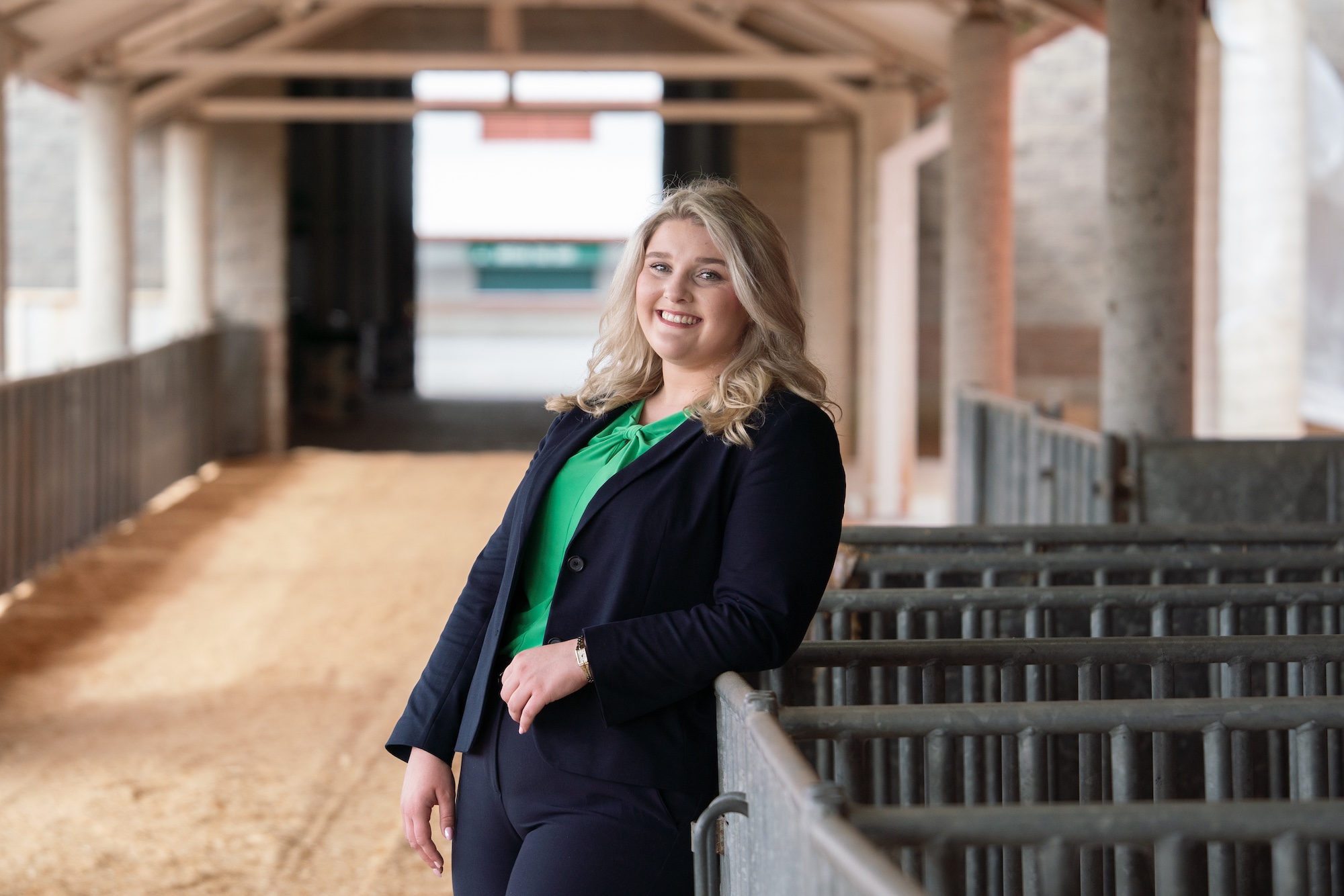
For Mary Grace Winfrey, ’28, agriculture was never something she had to seek out. Growing up in Kite, GA, it was simply part of life.
She was active in 4-H and Future Farmers of America (FFA), showed pigs and participated in livestock judging. Many of the people around her made their living in agriculture, and Winfrey grew up understanding the rhythms and traditions of a rural community. But she never imagined agriculture would become part of her professional life.
“I saw those as the ‘fun’ parts of my life,” Winfrey said. “While many people around me made their living in agriculture, I didn’t think that could be me.”
Now, as a Mercer Law student, Winfrey is discovering that there is more than one way to be part of the agricultural world. Her first-year summer internship with the Georgia Department of Agriculture and her current research fellowship with the National Agricultural Law Center have introduced her to a field of law that connects her legal education with the rural community where she grew up.
“This work has shown me that I can be part of that world in a different way,” she said, “and it has helped me better understand the type of work I find meaningful.”
Winfrey spent her 1L summer in Atlanta with the Legal Services Division of the Georgia Department of Agriculture. Her work gave her a behind-the-scenes look at the legal issues involved in one of the state’s largest and most varied industries.
She drafted administrative orders for various divisions within the Department, updated contracts for the State Farmers Markets and prepared Order of the Court files for the Attorney General’s Office. She also learned about settlement conferences and the state agency rulemaking process. Perhaps just as valuable was the broader perspective the internship provided. “It showed me the many different sectors that make up Georgia agriculture,” Winfrey said.
Her interest continued through a research fellowship with the National Agricultural Law Center, where she writes about legal issues affecting the agriculture industry. The Center provides objective research on agricultural and food law for farmers, lawmakers and attorneys.
Winfrey has written an overview of seafood regulation and is currently researching legislative proposals affecting livestock and poultry slaughter and processing. She also has helped maintain the Center’s Reading Rooms, collections of resources on specific areas of agricultural law. She updated the Endangered Species Act Reading Room and is now working on Aquaculture. The work has strengthened her legal research and writing skills while teaching her how to make complicated legal issues understandable and useful to people outside the legal profession.
That is a skill Winfrey is learning to value as she considers where her legal career might take her. “I didn’t come to law school with a specific practice area in mind, and I’m still exploring,” she said.
Winfrey’s path to law school has been anything but conventional. She began dual enrollment during her freshman year of high school, and the college credits she earned allowed her to graduate from both high school and college early. She earned her degree in criminal justice with a concentration in social justice from East Georgia State College in 2025 and entered Mercer Law at age 20.
She is a first-generation law student, and because she did not know any lawyers growing up, the legal profession was unfamiliar territory. Her interest in law developed gradually. Growing up in a rural community, she saw how difficult it could be for people to find legal assistance. Then, while in high school, she had an opportunity to advocate for issues she cared about.
“I loved the process of researching an issue and making my case,” she said.
Law school became a possibility. Later, while working at a public defender’s office in college, she got her first close look at the work attorneys actually do. “That was my first time being exposed to the work attorneys do,” she said, “and it made me realize that practicing law was something I could see myself doing.”
Her connection to rural communities remains important. At Mercer, she serves as president of the Rural Law Student Association, helping connect students with rural practitioners and encouraging conversations about practicing law outside Georgia’s largest cities.
Professor Margie Alsbrook, whose teaching and scholarship focus on agricultural law, has played an important role in Winfrey’s exploration of the field. Another student from Alsbrook’s agricultural law seminar had previously worked at the Georgia Department of Agriculture and encouraged Winfrey to apply. Alsbrook also recommended the National Agricultural Law Center fellowship, drawing on her own experience earning both her J.D. and LL.M. in Agricultural & Food Law. More than simply pointing her toward opportunities, Winfrey said Alsbrook has encouraged her to consider how her background might inform her future as a lawyer.
“Professor Alsbrook is always willing to share her own experiences and make connections for her students,” Winfrey said. “She has helped me see how my background can shape the kind of lawyer I become.”
“Mary Grace is a wonderful student with a true passion for Ag Law, and we are lucky to have her at Mercer,” said Alsbrook. “We have a number of students who are interested in how the law impacts agriculture and the food system, which covers everything from planting and breeding through harvesting and processing and packaging up through transportation, sale and consumption. It is an area of the law that impacts everyone, and it is especially important to the overall economic health of Georgia and the Southeast.”
That sense of connection is also one reason Winfrey chose Mercer.
She wanted a law school where she could build relationships with professors and classmates, and being less than an hour and a half from home mattered, too. The Woodruff Scholarship was an added blessing. The George W. Woodruff Scholarship is a merit-based scholarship awarded to four members of each entering class. This scholarship covers tuition and a $5,000 annual stipend for books and living expenses. “From the beginning, Mercer felt welcoming,” she said. “The small class sizes have allowed me to get to know the people around me, and the professors are truly invested in their students.”
For Winfrey, that community has extended well beyond the classroom. In addition to leading the Rural Law Student Association, she is a member of the Association of Women Law Students and Phi Delta Phi and serves as a group mentor for two sections of Introduction to Legal Research. This year, she is also taking Civics Field Placement, teaching civics to local high school students. In August, she and her close friend and classmate Courtney Martin, ’28, won the Intraschool Client Counseling Competition.
And while she is continuing to explore different areas of law — including an upcoming internship with Hall Booth Smith that will give her broader experience — agricultural law has given Winfrey something she did not expect when she entered law school: a new way to see the place she has always called home. The girl who once thought of 4-H, FFA, pigs and livestock judging as simply the fun parts of growing up in rural Georgia is beginning to see them differently. They were not just pieces of her childhood. They may become part of her future, too.