More Than Making Great Lawyers: Craig Senn
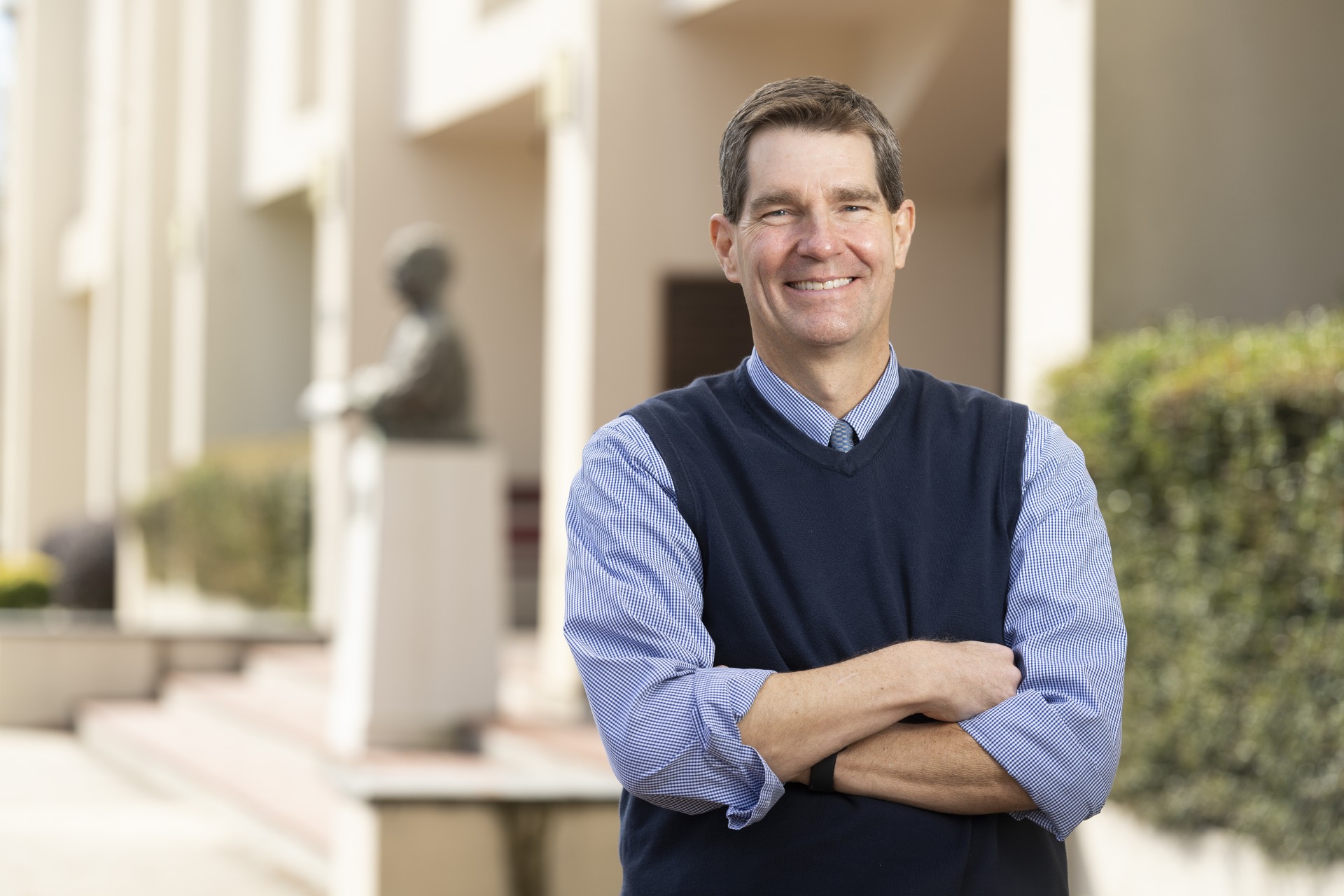
For Associate Dean for Faculty Research & Development and Professor of Law Craig Senn, the decision to become a lawyer began long before he understood where a legal career might take him.
He was about 12 years old when he discovered books about criminal cases and the death penalty. There were no lawyers in his family, but something about those stories captured his attention. “It opened my eyes to the law, and I was hooked,” he said.
That early curiosity led Senn to the University of Georgia, where he earned a bachelor’s degree in philosophy, and then to the University of North Carolina School of Law, where he graduated in 1995. He began his career as a labor and employment lawyer in Atlanta, practicing at Wimberly & Lawson and then Womble Carlyle Sandridge & Rice (now Womble Bond Dickinson). He hadn’t planned to leave practice for the classroom. Then his wife, Sharon, had an idea.
In 2003, Sharon was taking an MBA business law course at Georgia State University, which covered workplace legal issues. Knowing that Senn had been practicing labor and employment law, she suggested he might enjoy teaching. “I said no, because I enjoyed the practice, the firm and my colleagues,” he said. But Sharon persisted. More than 20 years later, Senn calls teaching law “a privilege.”
Senn teaches Employment Law, Employment Discrimination, Labor Law and Contracts I and II. His years in practice continue to influence how he approaches the classroom, particularly his emphasis on organization and clear communication.
“Those skills are invaluable for us lawyers,” he said. “If we can organize a difficult topic and clearly communicate concepts, learning becomes easy for everyone—judges, juries, other lawyers and students.”
His experience also gives him perspective on what students will encounter after graduation. One lesson, he said, is that practicing law is fundamentally about relationships.
“The legal profession—whether at a firm or otherwise—is about relationships with people, including clients, colleagues, opposing counsel and judges,” he said. “A lawyer’s ability and willingness to work with others plays a big role in professional success and satisfaction.”
Senn also wants students to understand that joining the profession is not simply about mastering legal doctrine. It is about developing the habits and skills that allow them to become effective professionals. That focus is one of the things that impressed him most during his first year at Mercer Law. Senn said, “Mercer Law’s dedication to instilling a sense of professional identity in our students” stood out to him. Students that begin that process during orientation and their first year and continue it throughout law school.
“Our graduates have a clear understanding of what it means and takes to be a part of this legal profession,” he said. “We help to make great lawyers here; we also try to make great professionals.”
Senn hopes his students leave his classes with two things: enthusiasm for the legal profession and an appreciation for the importance of good legal writing. The first can be difficult to maintain when students are facing the demands of three years of law school. “Law students see the mountain of work in front of them during the 1L, 2L and 3L years—to the point that it may prevent them from seeing just how wonderful this profession and the law school learning process can be,” he said. He wants his classes to help students see beyond the workload and remain excited about what they are preparing to do. He is equally emphatic about writing.
“As they say, easy reading is hard writing,” he said.
In practice, Senn saw firsthand how strong legal writing could influence a case. “I’ve seen good legal writing win the day so many times.”
That lesson remains central to his teaching and aligns closely with Mercer Law’s emphasis on legal writing. Senn continues to hone his own writing through scholarship, recently completing an article examining a causation issue in sexual harassment cases that will be published in the Wake Forest Law Review in 2027. He enjoys the process of identifying a difficult issue for the courts, researching the competing perspectives and developing a solution that future courts might consider. The work also informs his teaching.
Senn’s definition of professional fulfillment has not changed since he became a lawyer. What has changed is where he finds it.
“I did not become a lawyer for money,” he said. “Like others, I entered the profession to help people and make a positive impact.” In practice, that meant helping clients with their legal issues and cases. As a professor, the impact is different. “As a teacher, my fulfillment comes from, hopefully, making a positive impact on how students see a subject, discover a career path, or view the legal profession overall.”
After about 10 years in private practice and more than 20 years teaching, Senn is particularly excited about serving as a mentor to Mercer Law students. “I get excited about sharing some learned lessons with students and, in turn, seeing them get excited about becoming lawyers,” he said.
For him, the rewards can be found in many forms: a student mastering a difficult concept, succeeding on an exam, winning a moot court or mock trial competition or landing a job. “We love to see our students’ hard work pay off,” he said.
After his first year at Mercer, Senn said the people are what stand out most. “Our students are smart and work hard, but they are also good people who help one another,” he said. “Our administration, faculty and staff all love this school and our students.” He also credits Dean Sneddon and the administration, faculty and staff for their talent and shared commitment to Mercer Law. “Together, all of these people make Mercer Law a unique place.”
Senn and Sharon have also quickly embraced life in Middle Georgia. Sharon is from Albany, GA, while Senn grew up in the Atlanta area, making Macon feel like a natural meeting point for their Georgia roots. “We love it here!” he said. They run and hike, visit peach orchards and pecan groves, enjoy the food at the Georgia National Fair in Perry and spend time with family in Atlanta. Their family also includes their daughter, Sarah, a sophomore studying mechanical engineering at Notre Dame, and two rescue dogs, Bandit and Buzz.
For Senn, though, this chapter is about more than settling into a new community. It is about helping shape the lawyers who will come next. A boy who became fascinated with the law at 12 has spent a career practicing it, teaching it and now mentoring the people who will carry it forward.
His hope is simple: that his students recognize the law as a demanding profession, but also an exciting and rewarding one—and understand that becoming a good lawyer requires more than knowing the law.
It requires knowing how to communicate, how to work with people and, ultimately, how to make a difference.