The Law Feeds Her Tummy, the Music Feeds Her Soul
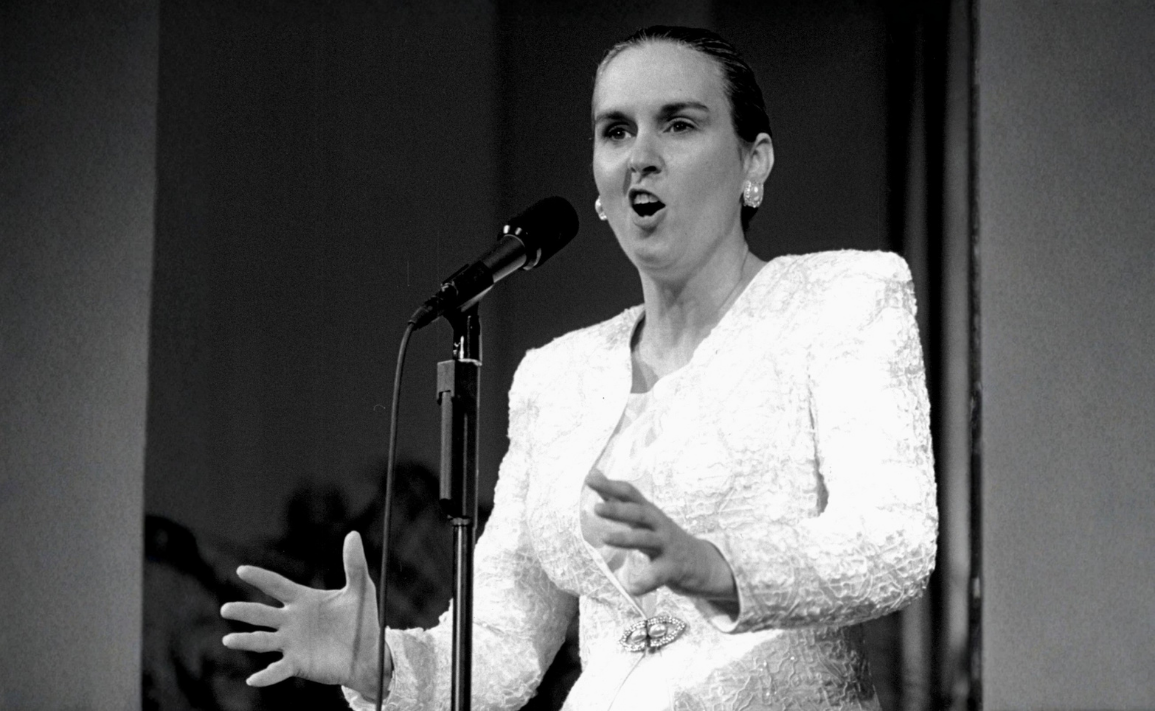
For most of her professional life, Judge Vi Bennett,’81, has occupied two very different stages.
On one, she presides from the bench, managing courtrooms, hearing cases, and making decisions that profoundly affect the lives of others. On the other, she stands beneath stage lights or before a congregation, her voice carrying everything from sacred oratorios to cabaret standards. One role demands authority and restraint; the other invites emotion and expression.
For Bennett, however, the two pursuits have never been in conflict.
“The law feeds my tummy,” she often tells audiences who are surprised to learn that the woman in concert attire is also a judge. “But music feeds my soul.”
That philosophy has guided a life in which a distinguished legal career and a lifelong passion for singing have continually intersected, each enriching the other.
Music arrived early.
Like many singers, Bennett’s first audience was a church congregation. Growing up in a small family church where her grandfather preached, one aunt played piano, and another served as song leader, she became captivated by music before she fully understood it.
Her mother often recalled one of the earliest signs of that fascination. After bringing sheets in from the clothesline, she heard her daughter singing the familiar hymn “Bringing in the Sheaves,” except with a child’s lyrical revision: “Bringing in the Sheets.”
The church provided more than inspiration. It provided opportunity. By seventh grade, an elementary school music teacher recognized Bennett’s talent and recommended voice lessons. Her instructor, who also served as minister of music at First Baptist Church in Jesup, immersed her in a thriving youth music program.
Soon she was participating in Georgia Baptist Convention choir festivals, where youth choirs competed and individual students were evaluated in conducting and accompanying competitions. During one such event, Dr. Hildegard Stanley, head of the music department at Brewton-Parker Junior College, offered her a voice scholarship.
The offer opened a door to formal musical training and reinforced what she already knew: music would always be part of her life.
“I have always known that music would be an important part of my life,” Bennett says. “It is so much a part of who I am that someone can say a phrase or even a word and a song with that word or phrase pops into my head.”
Yet another ambition was beginning to emerge.
After graduating from Brewton-Parker, she enrolled at Mercer University and continued studying voice briefly. Before long, however, she made a practical decision. Music would have to wait while she focused on academics and her goal of earning admission to law school.
The pattern would repeat itself throughout her life. Whenever professional responsibilities demanded center stage, music stepped quietly into the wings. It never disappeared entirely. It simply waited for its next entrance.
After law school, Bennett joined the District Attorney’s Office in Savannah as an assistant district attorney. Once again, music returned.
She became a soloist with the Savannah Symphony Chorus and performed with an early-music vocal ensemble, including appearances associated with the Spoleto Festival in Charleston, South Carolina. Before leaving Savannah in 1984, she presented a cabaret-style farewell performance on Wilmington Island attended by colleagues from the DA’s office, defense attorneys, and friends.
That evening would prove unexpectedly significant.
Several audience members maintained connections in Savannah’s arts community, relationships that would later create opportunities Bennett could never have anticipated. Yet after moving back to Jesup, the realities of balancing career and artistic pursuits reemerged. Weekly three-hour round trips to Savannah rehearsals eventually became unsustainable, and music once again moved to the background.
Then fate intervened.
In 1992, Bennett was appointed as an inaugural member of Georgia’s Department of Children and Youth Services, now the Department of Juvenile Justice. Frequent meetings in Atlanta required overnight stays. During one trip, she picked up a magazine featuring a newly created Savannah arts festival and its American Traditions Vocal Competition.
The festival’s executive director was Elizabeth Stewart, a former colleague from the Savannah District Attorney’s Office who had attended that farewell cabaret years earlier.
Soon afterward, the two women unexpectedly crossed paths in a Savannah health food store. Stewart encouraged Bennett to enter the competition.
She did.
Among more than 200 applicants, she advanced to the quarterfinals and earned an invitation to perform live. Upon arrival, Bennett discovered she had misunderstood the nature of the competition. Most contestants were professional performers, university faculty members, opera singers, or Broadway veterans.
Their résumés detailed impressive professional accomplishments. Hers reflected a lawyer who simply loved to sing.
Rather than discouraging her, the experience reignited a passion that had never truly faded.
Bennett resumed voice study with Dr. Lucinda Schultz at Armstrong College and later expanded her training in New York under renowned vocal teacher Joyce Hall, whose students included Glenn Close, Kevin Kline, and Julie Andrews.
Over the next six years, Bennett repeatedly advanced to the competition’s quarterfinal rounds. In 1999 she reached the semifinals and won the competition’s inaugural People’s Choice Award. The following year she joined fellow semifinalists Bill Lewis and John English in a production titled Three for Tonight, which ran during the Savannah festival and later toured additional venues.
By then, however, another major transition was underway. Bennett had left her law firm, opened her own practice, and once again found herself making difficult decisions about time and priorities.
“You have to prioritize what things are most important to you and you make sacrifices,” she says. “When I was practicing law, I would use my vacation time for performances or trips to study in New York.”
Her legal career continued to flourish, eventually leading her to the bench, where she serves today as a state court judge in Wayne County, Georgia. Yet even judicial responsibilities could not completely silence the music.
Another chance encounter led her to a choral group in Fernandina Beach, Florida, organized to perform Handel’s Messiah. Bennett auditioned, joined the ensemble, and soon developed a relationship with Amelia Plantation Chapel. There she became a soprano soloist, performing major sacred works accompanied by members of the Jacksonville Symphony, including Saint-Saëns’ Christmas Oratorio and Schubert’s Mass in G.
Later, she returned her musical focus closer to home, singing with the chancel choir at Jesup First United Methodist Church. Her final major solo engagement before the pandemic was a Valentine’s banquet performance in February 2020.
Even today, music continues to find its way into Bennett’s life. She occasionally sings at funerals, performs the National Anthem at veterans’ events, and is known to entertain fellow judges during awards banquets. A few years ago, one of her musical connections invited her to join a 150-voice choir and full orchestra performing in New York’s famed Carnegie Hall.
After decades of believing her singing career had ended, she once again discovered otherwise.
The connection between law and music may seem unlikely, but she sees remarkable similarities.
“The practice of law, particularly trial work, and the singing of songs is a performance,” she explains. “Both require preparation. Both teach you to think on your feet.”
More importantly, both rely on communication and emotional understanding.
“I think the vocal repertoire can emit much more emotion than an instrumental piece,” she says. “The words and the music together speak more freely to the average person. A singer learns the nuances in tone, volume, and rhythm to evoke those emotions. A good trial lawyer does the same to persuade a jury. A good judge does the same to calm down a courtroom or reassure a defendant.”
Still, the emotional outcomes differ.
“When someone is in my courtroom, they are not happy, sometimes even if they win,” she says. “When someone comes to a performance it is because they want to be there and they are usually happy. I prefer to bring happiness.”
That understanding has shaped Bennett’s view of balance and fulfillment.
“Balance for me is to be present in the moment as best I can,” she says. Whether hearing a difficult case, traveling with friends, performing music, or pursuing hobbies, she believes fulfillment comes from fully engaging with the experience before you.
It is advice she readily offers to lawyers and law students.
“If you are lucky enough to be passionate about something in addition to the law, find a way to keep that passion,” she says. “It may not always be your primary focus, but it can be like a very good friend that has moved away. When you get the chance to reconnect, it is as if no time has passed at all.”
Her own story proves the point. Across decades of legal practice, judicial service, and musical performance, music has never truly left her life. It has simply waited patiently between acts, returning whenever the timing was right.
And if history is any indication, the final curtain has not yet fallen. As she readily admits, every time she thinks her music days are behind her, music somehow finds its way back.